
 We are delighted to introduce the first of a new quarterly column by automata maker and enthusiast Dug North. The column will focus on automata construction techniques and assorted methods of creating motion. Dug will also highlight the works of various automata makers, (some you are sure to have heard of and some you probably have not).
We hope you enjoy this new column and encourage you to post comments and questions for Dug at the end of each quarterly article.
Eight Lessons Learned from Making a Wooden Clock
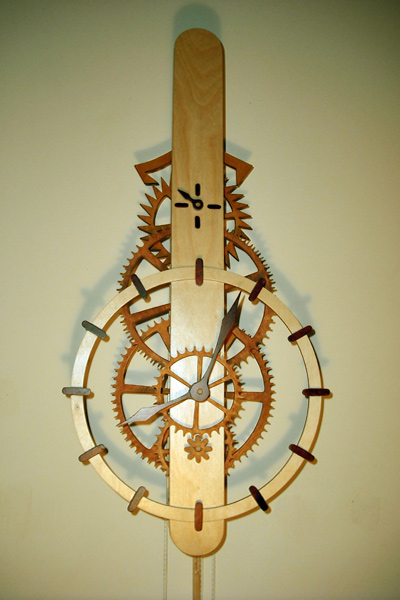
Because there is an age-old connection between clock-making and automata, I suspected there was a lot an automata-maker could learn in constructing a clock. So, I decided to build a clock called The Ascent. I learned some valuable lessons while building this clock, many of which might help you with your next mechanical wood project.
1. Baltic Birch Plywood is a Great Material
The Ascent clock is made of Baltic Birch plywood, an ideal clock or automaton material for a variety of reasons:
Dimensional Stability
Because plywood is made up of thin layers glued together, it’s less prone than most woods to swelling unevenly with changes in moisture. This stability will help any wooden mechanism – clock or automaton – run more reliably.
One Material, Many Sizes
The entire clock was made from 1/4 and 1/8 inch thick sheets of plywood. For thicker parts, I merely stacked and glued several piece together. When an especially long piece was required, a scarf joint and glue did the job.
Cutting Identical Parts
Another advantage of using thin plywood is that identical parts can easily be produced by stacking the pieces, holding them together with double-sided tape, and cutting them all at once. One pass of the saw versus many!
Wood Can Act as a Spring
In two places within the clock, plywood itself is used as a spring. The winding mechanism has flexible wood pawls that engage a ratchet wheel. The adjustable bob on the end of the pendulum is held in place by the springy action of a small plywood arm applying pressure to the shaft. Using wood as a spring could be a useful technique in making automata as well.
 2. Dowels are Not Necessarily Round
This can be a serious problem if the dowels/axles of your clock or automaton are so irregular that they do not spin smoothly inside the holes that serve as bearings. The Ascent parts kit came with a simple gauge to test whether the 1/4 inch dowels were round. The gauge consists of 1/4 inch notch precisely cut into a small piece of plywood. By inserting the end of a questionable dowel into the gauge’s notch and spinning it, I could tell instantly if the dowel had potentially problematic high spots. Try making similar gauges to test dowels for your projects.
 3. Use Bearings to Reduce Friction
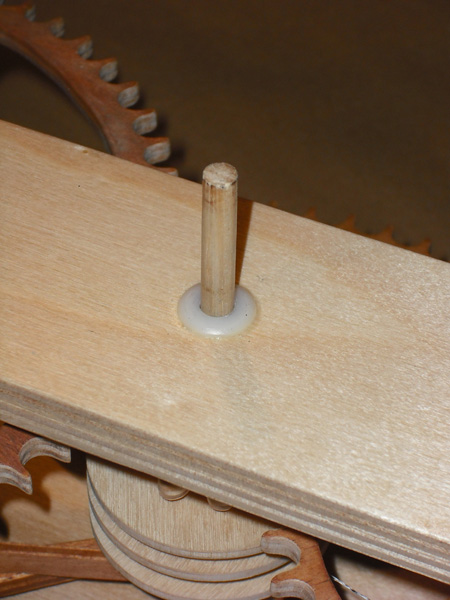
If an irregularly shaped dowel will not spin easily in a hole of a similar size, what can you do? Fortunately, the designer of The Ascent had an effective solution. The parts kit contained a number of ‘nylon shoulder washers’ with interior holes measuring 17/64ths of an inch. A washer was installed at every point where a dowel end met the clock’s frame. Since the washer’s hole is 1/64th of an inch larger than the dowel’s supposed diameter, this allows all but the worst dowels to rotate freely. Also, nylon has the added advantage of being a material with a very low coefficient of friction.
4. Graphite Makes a Surprisingly Good Lubricant on Wood
Only a few spots on the clock required lubrication, which consisted of drawing on the wood parts with a lead pencil. Pencil “lead” is actually clay and graphite mixed in varying amounts to create harder or softer pencils. Like nylon, graphite has a very low coefficient of friction. For best results, use a soft pencil — usually designated with a number followed by the letter “B”. The graphite can smear and mar the finish of your piece, so take care in its application and in handling the lubricated part.
5. Sanding Wood Parts Can Reduce Friction
The clock instructions suggested sanding the mechanical parts with progressively finer grits of sandpaper: from 150, to 220, to 400, and finally 600. That’s a lot of sanding. Were the hours spent on this laborious task worth it? Absolutely. The performance of the clock improved noticeably after sanding and it required less weight to drive it. If you are having trouble making parts move smoothly — smooth the parts!
6. How to Reduce the Size of Drilled Holes
What do you do if you are trying to friction-fit a part such as a cam to a dowel serving as an axle but the hole in the cam is just a bit too big? The clock instructions provided an invaluable tip. Simply take some white or yellow PVA glue, and apply a thin coating to the inside of the hole. After allowing the glue to dry, try the fit of the piece on dowel again. You should find that the part is a tighter fit. If it is still too loose, just repeat the process.
 7. Make the Right Tool for the Job
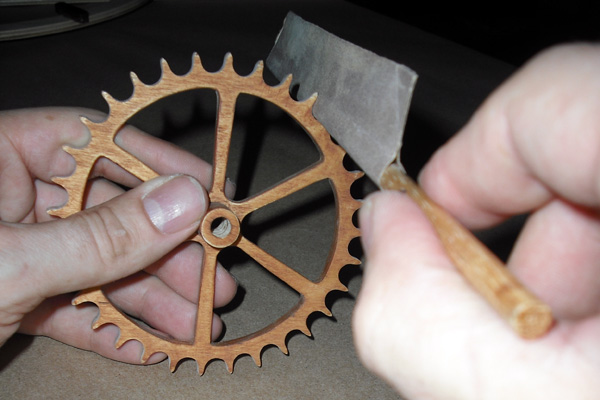
We have all heard that it is important to use the right tool for the job. Sometimes, the “right” tool for the job may not exist! The Ascent clock includes many gears with as many as 64 teeth each. Sanding those teeth was a major task. To aid in the process, I glued some sandpaper around a 1/4 inch dowel leaving both ends of the sandpaper longer than was needed to reach around the dowel. This formed a gentle curve of sandpaper that matched the gear tooth profile. I made a set of these sanding sticks with the required grits of sandpaper and worked through them progressively with great results.
8. Sophisticated Mechanisms Can be Made from Wood
A clock is a delicate mechanism. It is easy to tell when something is wrong: it simply stops working. Now that I have made an all-wood clock that actually keeps time, I am further convinced that nearly anything can be made from wood. Now that is a lesson worth remembering whenever you create something of your own! For more information on The Ascent Clock clocks kit, materials, and plans click here.
 Dug’s Automata Tips, Techniques and Tricks
A quarterly column by automata-maker and enthusiast Dug North
Copyright 2011 Dug North
Warning: The topics covered in this column include the use of tools and materials that have the potential to cause damage to property and/or bodily injury. Your safety is important and it is your sole responsibility. Always read and follow the safety instructions that come with tools and materials you use. Wear safety glasses, use guards and other forms of safety equipment, follow safety precautions, and use good judgment. Seek the guidance of experienced outside sources whenever required.

Charles says:
Kudos to CMT and Dug for this new column. Good tips for automata-makers and woodworkers alike. It’s the sharing of knowledge and experience like this that will help keep the art of automata making from vanishing.
Dug North says:
Thanks Charles! I am glad you found the tips useful!
Bernie says:
I think a tips column is a fantastic idea. I have been trying to make automata for a while and get stuck, so search the internet for ideas, tips from experienced makers can save a lot of heartache and wasted time. I have seen Dugs work and find it inspiring. Lets have more Dug!
Mike says:
Useful Dug – thanks. Can you advise where to get nylon shoulder washers or do they only come with this kit?
Jim Schmitt says:
Nylon Shoulder washers (bearings) can be obtained in retail quantities from MOUSER ELECTRONICS web site.
Dug North says:
Thanks Bernie! Stay tuned for more tips in the near future. If there are particular topics you would like to see covered drop me a line via the contact form on my web site.
Dug North says:
@Mike – Glad you found it useful! The nylon shoulder washers did come with the clock’s hardware kit. I have also been able to find them at my local hardware store (an Ace Hardware located in the Northeastern U.S.). I’m sure they are available many places online. One such place is Amazon’s Industrial and Scientific section where you can get a pack of 100 nylon shoulder washers for just over $6 USD: http://www.amazon.com/gp/product/B000FN1II0/
Marc Horovitz says:
Be careful about using pencil lead as a lubricant. While the graphite in the pencil lead is an excellent lubricant, the clay contained therein (even in soft leads) is an abrasive. You can buy powdered graphite at Lowes. It might be a little messier than pencil lead but it won’t eat up your bearings while it lubricates them. Check out: http://www.lowes.com:80/pd_34006-37672-703185_4294936478+4294961530_41_?catalogId=10051&productId=1244381&Ne=41&identifier=Hillman&N=4294936478+4294961530&langId=-1&Ns=p_product_prd_lis_ord_nbr%7C0%7C%7Cp_product_quantity_sold%7C1&storeId=10151&searchQueryType=1
Dug North says:
@Marc – Thank you. That is an *excellent* point and one I had not considered. Any advice on how to apply that superfine powder to a specific spot on a wooden mechanism?
Marc Horovitz says:
Concerning the application of powdered graphite, I cannot advise, as I’ve never used it (at least for automata). For general machine lubrication, it’s messy, so may not be suitable for automata. However, I did find chunks of pure natural graphite online, which could be used in the same manner as pencil lead. It’s a little pricey but one chunk would probably be a lifetime supply. Check out: http://www.google.com/products/catalog?hl=en&q=graphite+chunk&cid=8208800506662513488&os=sellers#
Dug North says:
Great find, Marc!
Would you believe there is an online store dedicated entirely to graphite? Here’s an extruded graphite rod with a 1/2″ diameter measuring 12″ long:
http://www.graphitestore.com/itemDetails.asp?item_id=454&prd_id=25&cat_id=22&curPage=1
-Dug
Theodore Other says:
I’m a tremendous fan of your work, great detail. A trick I use to make a dowel smooth and round is to drill a slightly smaller hole in a block of wood that’s as hard or harder than the dowel, then take a section of the dowel chuck it in a drill press and raise the block up the dowel spinning. A 5/16″ dowel can be brought down to a 1/4″ if its got a large flat on it. Seems like it squeezes the wood pores tighter together. But, it does leave the dowel with a sheen and smooth feel.
Dug North says:
Thanks, Theodore!
I, too, have burnished and compressed wood, but mostly by accident — by using the machine a lot or taking it apart and putting it back together a dozen times. I’ve certainly noticed that it helps, but have never tried to do it on purpose. I’ve noticed that it works quite well on hardwoods such as cherry.
Thanks for sharing your technique!
-Dug