Sketchbook Moment No.54
January 10, 2012 by admin
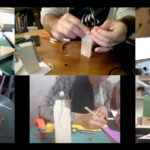
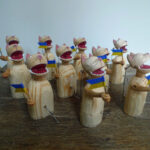
The Boyhood of Hitler
Watch out everyone. He’s having a big idea
Click image to enlarge.
Dug’s Automata Tips, Techniques and Tricks No.6
December 19, 2011 by admin
21 Rotary Tool Tips and Tricks for Automata-Makers
The high-speed rotary tool can do the work of dozens of other tools. With the right bits and accessories, this little powerhouse can cut, carve, engrave, drill, grind, sand, brush, and polish a variety of materials! Here are some tips to help automata-makers get the most from a rotary tool.
1: Choosing a Rotary Tool Try to choose one that has at least two speeds — more if possible. Depending on the material to be cut, different bits will work best at specific speeds.
2: Wear Eye Protection Because of the extremely high speed at which the tool operates, it is essential to wear eye protection at all times when using a rotary tool. Some operations require hearing protection and a particle mask as well.
3: Let the Tool Do the Work The speed of the spinning tool should do the work — not the force you apply. Always use light pressure and make multiple passes if needed. This will give you more control and keep your bits from wearing out quickly, or worse, breaking.
4: Sand with the Direction of Spin When sanding wood, move the tool in the same direction as the debris that is being thrown from the spinning bit. This will give you the smoothest finish.
5: Replacing Sanding Drums Unscrew and remove the rubber drum from the mandrel completely. Dust the rubber with talc powder, slip the new sleeve on the rubber drum, and screw it securely to the mandrel.
6: Sanding Cams to Shape Sanding drums are great for shaping wooden cam profiles. Sometimes you can do this while the cam is mounted in the automaton — a great time saver!
7: Sanding Fine Details in Wood Specially designed radial bristle brushes allow you to sand fine carvings without loosing detail. You can make an inexpensive version with a small section of an abrasive cleaning pad screwed to the end of a mandrel.
8: Set Up for Carving A flexible shaft attachment makes carving with a rotary tool much easier. These shafts work best with the tool suspended from a hanger. You will be making some dust, so wear a particle mask and place a fan nearby while working.
9: Roughing-out Carvings Sanding drum accessories are great for bringing a carving to shape after sawing it out. Start with a large, coarse grit drum and move to a smaller drum with a finer grit of sandpaper as your carving becomes more detailed.
10: Carving with Stones Wood carving bits often leave a rough surface on woods such as Basswood (a.k.a. Lime). Try using grinding stones for the final stages of carving. The pink/orange/brown Aluminum-oxide stones remove material a little faster, while the darker gray/blue/green Silicon-carbide stones remove material more slowly, but leave a smoother finish.
11: Cleaning Wood Cutting Bits and Sanding Drums Many professional woodcarvers recommend using chemical oven cleaner to clean sawdust out of metal woodcarving bits. You can also try burning the wood out with a small torch. To clear out stones, sanding drums, and sanding discs, run the tool against an abrasive belt cleaner.
12: Cut Metal Against the Direction of Spin When cutting metal it helps to move the tool opposite to the direction that the debris is being thrown. Mount the piece to be cut in a vise, and hold the tool firmly with two hands because the tool will attempt to “climb” up and over the object being cut.
13: Dealing with Brittle Cut-off Wheels If you’re breaking the thin cut-off wheels when cutting metal, stack two wheels together and screw them both to the mandrel. For the thicker, fiberglass reinforced cut-off wheels, a small washer placed on either side of the disc will increase the rigidity of the wheel.
14: Removing Stripped Screws Brass screws are fairly easy to strip. Use a cut-off wheel to make a notch across the head of the screw, then back out screw with a flat-head screw driver.
Tips for Grinding and Shaping Metal
15: Deburring Tubing and Other Cut Edges Regardless of how you cut metal, a burr and/or sharp edge can be left behind. Use sanding drums or grinding stones in your rotary tool to quickly smooth them.
16: Rounding the Tips of Pinwheels Pinwheels that are less-than-perfect can sometimes jam. Rounding over the jamming pin ends can help.
17: Sculpting Metal There is nothing harder than diamond. When used in a rotary tool, diamond coated bits allow you to shape almost any kind of metal, even steel.
Tips for Drilling
18: Drilling it Tight Spots If you need to drill a hole somewhere that is hard to reach, a drill bit in a flexible shaft attachment will sometimes fit where other tools cannot. The right angle drilling accessory will also allow you to reach some very tight spots.
19: Drilling Holes in Glass Yes, you can use a rotary tool to drill holes in glass! You will need a diamond hole-cutting bit and lubricant. You also need a multi-speed rotary tool so you can use a slower speed. Apply light pressure, drill for a few seconds at a time, then apply more lubricant. Carefully repeat this process until you’ve penetrated the glass.
Tips for Getting Most out of Your Tools
20: Breathing New Life into Old Tools You can save money by picking up second-hand tools and restoring them yourself. By using grinding stones, brushes, and polishing buffs, you can sharpen, clean, and polish old tools back into working order.
21: Accessorize! There are many accessories that can be attach to a rotary tool. When used in conjunction with the right bits, a rotary tool can be transformed into a wood cutting saw, miniature router, wall tile saw, planer, drill press, glass engraver, and more. Here’s a handy online bit-finder tool. The high-speed rotary tool is a versatile tool that can grow with you and your projects!
For a list of materials and further reading visit Dug’s Tools and References page.
Dug’s Automata Tips, Techniques and TricksA quarterly column by automata-maker and enthusiast Dug North
Copyright 2011 Dug North
Warning: The topics covered in this column include the use of tools and materials that have the potential to cause damage to property and/or bodily injury. Your safety is important and it is your sole responsibility. Always read and follow the safety instructions that come with tools and materials you use. Wear safety glasses, use guards and other forms of safety equipment, follow safety precautions, and use good judgment. Seek the guidance of experienced outside sources whenever required.
Not Yet by Paul Spooner
November 14, 2011 by admin
A new limited edition from Paul Spooner.
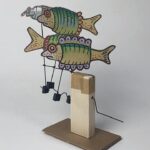
‘Another piece that exploits the attractive/repulsive effects of neodymium magnets. The handle turns a cylinder in which a magnet is inserted radially so that its poles alternate, causing a magnet buried in the fish to feel attracted or repelled by turns. The foil, which is pure tin and beautiful stuff in its own right, stops the fish from becoming airborne.
I didn’t think of a title until I was half-way through making the batch. When I was at art school there was a kiln in the pottery on which the tutor often chalked; “NOT YET” to stop people opening the door too soon. If I don’t admit to not knowing quite why this piece has the same title, some people might think that it represents some deep thought about time and existence.
Finishing them on Remembrance Day, and having to date-stamp them 11/11/11 will only add to the suspicion that I’ve started taking myself too seriously’.
Dimensions
80mm Wide x 40mm Deep x 50mm High
£41.50 (Excl. VAT)
Lab Birds
November 7, 2011 by admin
Fi Henshall’s latest piece The Lab Birds features two birds with an interest in science.
The intricate mechanism includes bellows, cams and linkages, which produce realistic bird tweets, and graceful movements on the inquisitive birds.
Wood, metal and paint.
Dimensions
40 cm High
21 cm Wide
13 cm Deep
£475 (excl VAT)
Sold
CMT presents Automata! at the Allen Gallery
October 11, 2011 by admin
This new exhibition of 20 exhibits from our collection is travelling to Hampshire for the run-up to Christmas this year.
Many of the exhibits are by Paul Spooner, including several of his iconic Anubis pieces.
Exhibition open 5th November to 24th December 2011
Opening Hours:
Tuesday to Saturday 10am – 4.30pm
Admission Free
Allen Gallery
Church Street
Alton
Hampshire
GU34 2BW


Join our
Subscribe to our
Follow us